Dear Brothers and Sisters in Christ,
As we conclude our celebration of the Lord’s Nativity and enter the new calendar year, we prepare to celebrate the Great Feast of the Theophany. Metropolitan Anthony of Sorouzh, of blessed memory, in his sermon given on this feast in 1998, helps us better understand and more fully enter into the meaning of what we celebrate. He writes:
“The day of the Theophany is the day when the whole world is being renewed and becomes a partaker of the saintliness of God. But at the same time, it is the day when Christ enters on the way to Calvary.
He came to John the Baptist on Jordan, not in order to be cleansed, because he was pure of sin, both as God and in the humanity made pure throughout the history of Israel by those ancestors who had given their lives to God and whose saintliness culminated in the all-purity of the Mother of God, so pure, so stainless that She could be brought into the Holy of Holies, into which even the High Priest dared not come except once a year, and only after a special sanctification.
Christ did not need cleansing. But these waters, into which all the sinners who had come to John the Baptist confessing the evil of their lives had washed themselves, were as it were heavy with the sinfulness and therefore the mortality of mankind. They had become waters of death, and it is in these waters that the Lord Jesus Christ merges Himself on that day, taking upon Himself the mortality resulting from the sin of man.
He comes, immortal in His humanity and His divinity, and at the same time He vests Himself with the mortality of the sinful world. This is the beginning of the way to Calvary. This is a day when we marvel at the infinite love of God. But as on every other occasion, man had to participate completely in the ways of salvation which God had provided. And this is why Christ comes and becomes partaker of our mortality, to save us. The culminating point will come on Calvary when He will say, 'My God, my God, why hast Thou forsaken me?' It will be a moment when God as He was in His humanity will have lost communion with the Father by partaking of the destiny of mankind. This is the ultimate act of divine love.
Let us therefore today wonder and marvel, and worship this love of God, and learn from Him; because He said in the Gospel, 'I have given you an example. Follow it.' We are called, within the limits of our sinfulness and humanity, to carry one another's burdens, unto life and unto death. Let us learn from this. We find it so difficult to carry the burdens even of those whom we love; and practically impossible to shoulder the burdens of those whom we do not love with a natural, direct tenderness. Let us learn, because otherwise we will not have learned the first lesson which Christ gives us when He enters upon His ministry. Amen.”
Indeed, let us wonder and marvel at God’s love for us. Let us learn from the Lord and implement what we have learned in our daily lives throughout the coming year. Be assured of my prayerful best wishes for a year that is filled with the love, peace, and joy that can only come from knowing the Lord Who was born to save us.
With love in the Lord,
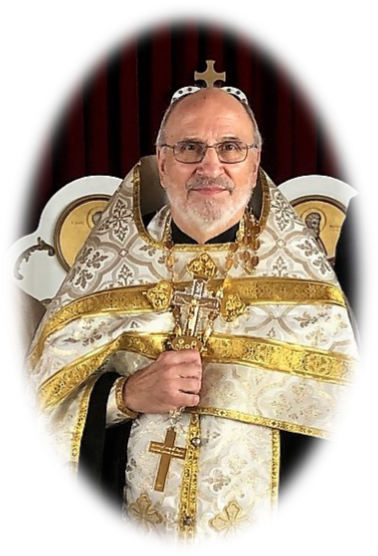
Father David
Archpriest
David Brum, Rector
Protodeacon
Alexis Washington
Regular Services
Saturday:
5:00 PM Great Vespers
Sunday:
9:00 AM Divine Liturgy
© 2012 - Saints Peter and Paul Orthodox Church 602-253-9515 All rights reserved.
|
For more information about our local monasteries, visit their websites |
|
Parish Contacts |
|
|
Stephanie A. Homyak, Church School Director & Newsletter Editor | |
|
480-759-6514 | |
|
bharp@vosymca.org | |
Saint John Chrysostom,
Archbishop of Constantinople
Discourse On the Day of the Baptism of Christ
We shall now say something about the present feast. Many celebrate the feastdays and know their designations, but the cause for which they were established they know not. Thus concerning this, that the present feast is called Theophany—everyone knows; but what this is—Theophany, and whether it be one thing or another, they know not. And this is shameful—every year to celebrate the feastday and not know its reason.
First of all therefore, it is necessary to say that there is not one Theophany, but two: the one actual, which already has occurred, and the second in future, which will happen with glory at the end of the world. About this one and about the other you will hear today from Paul, who in conversing with Titus, speaks thus about the present: “The grace of God hath revealed itself, having saved all mankind, decreeing, that we reject iniquity and worldly desires, and dwell in the present age in prudence and in righteousness and piety”—and about the future: “awaiting the blessed hope and glorious appearance of our great God and Saviour Jesus Christ” (Tit 2:11-13). And a prophet speaks thus about this latter: “the sun shalt turn to darkness, and the moon to blood at first, then shalt come the great and illuminating Day of the Lord” (Joel 2:31).
Why is not that day, on which the Lord was born, considered Theophany—but rather this day on which He was baptised? This present day it is, on which He was baptised and sanctified the nature of water. Because on this day all, having obtained the waters, do carry it home and keep it all year, since today the waters are sanctified; and an obvious phenomenon occurs: these waters in their essence do not spoil with the passage of time, but obtained today, for one whole year and often for two or three years, they remain unharmed and fresh, and afterwards for a long time do not stop being water, just as that obtained from the fountains.
Why then is this day called Theophany? Because Christ made Himself known to all—not then when He was born—but then when He was baptised. Until this time He was not known to the people. And that the people did not know Him, Who He was, listen about this to John the Baptist, who says: “Amidst you standeth, Him Whom ye know not of” (Jn.1:26). And is it surprising that others did not know Him, when even the Baptist did not know Him until that day? “And I—said he—knew Him not: but He that did send me to baptise with water, about This One did tell unto me: over Him that shalt see the Spirit descending and abiding upon Him, This One it is Who baptiseth in the Holy Spirit” (Jn. 1:33). Thus from this it is evident, that—there are two Theophanies, and why Christ comes at baptism and on whichever baptism He comes, about this it is necessary to say: it is therefore necessary to know both the one and equally the other. And first it is necessary to speak your love about the latter, so that we might learn about the former. There was a Jewish baptism, which cleansed from bodily impurities, but not to remove sins.
Thus, whoever committed adultery, or decided on thievery, or who did some other kind of misdeed, it did not free him from guilt. But whoever touched the bones of the dead, whoever tasted food forbidden by the law, whoever approached from contamination, whoever consorted with lepers—that one washed, and until evening was impure, and then cleansed. “Let one wash his body in pure water—it says in the Scriptures,—and he will be unclean until evening, and then he will be clean” (Lev 15:5, 22:4). This was not truly of sins or impurities, but since the Jews lacked perfection, then God, accomplishing it by means of this greater piety, prepared them by their beginnings for a precise observance of important things.
Thus, Jewish cleansings did not free from sins, but only from bodily impurities. Not so with ours: it is far more sublime and it manifests a great grace, whereby it sets free from sin, it cleanses the spirit and bestows the gifts of the Spirit. And the baptism of John was far more sublime than the Jewish, but less so than ours: it was like a bridge between both baptisms, leading across itself from the first to the last. Wherefore John did not give guidance for observance of bodily purifications, but together with them he exhorted and advised to be converted from vice to good deeds and to trust in the hope of salvation and the accomplishing of good deeds, rather than in different washings and purifications by water. John did not say: wash your clothes, wash your body, and ye will be pure, but what?—“bear ye fruits worthy of repentance” (Mt 3:8). Since it was more than of the Jews, but less than ours: the baptism of John did not impart the Holy Spirit and it did not grant forgiveness by grace: it gave the commandment to repent, but it was powerless to absolve sins. Wherefore John did also say: “I baptise you with water…That One however will baptise you with the Holy Spirit and with fire” (Mt 3:11). Obviously, he did not baptise with the Spirit.
But what does this mean: “with the Holy Spirit and with fire?” Call to mind that day, on which for the Apostles “there appeared disparate tongues like fire, and sat over each one of them” (Acts 2:3). And that the baptism of John did not impart the Spirit and remission of sins is evident from the following: Paul “found certain disciples, and said to them: received ye the Holy Spirit since ye have believed? They said to him: but furthermore whether it be of the Holy Spirit, we shall hear. He said to them: into what were ye baptised? They answered: into the baptism of John. Paul then said: John indeed baptised with the baptism of repentance,”—repentance, but not remission of sins; for whom did he baptise? “Having proclaimed to the people, that they should believe in the One coming after him, namely, Christ Jesus. Having heard this, they were baptised in the Name of the Lord Jesus: and Paul laying his hands on them, the Holy Spirit came upon them” (Acts 19:1-6). Do you see, how incomplete was the baptism of John? If the one were not incomplete, would then Paul have baptised them again, and placed his hands on them; having performed also the second, he shew the superiority of the apostolic Baptism and that the baptism of John was far less than his. Thus, from this we recognise the difference of the baptisms.
Now it is necessary to say, for whom was Christ baptised and by which baptism? Neither the former the Jewish, nor the last—ours. Whence hath He need for remission of sins, how is this possible for Him, Who hath not any sins? “Of sin,—it says in the Scriptures,—worked He not, nor was there deceit found in His mouth” (1 Pet 2:22); and further, “who of you convicteth Me of Sin?” (Jn 8:46). And His flesh was privy to the Holy Spirit; how might this be possible, when it in the beginning was fashioned by the Holy Spirit? And so, if His flesh was privy to the Holy Spirit, and He was not subject to sins, then for whom was He baptised? But first of all it is necessary for us to recognise, by which baptism He was baptised, and then it will be clear for us. By which baptism indeed was He baptised?—Not the Jewish, nor ours, nor John’s. For whom, since thou from thine own aspect of baptism dost perceive, that He was baptised not by reason of sin and not having need of the gift of the Spirit; therefore, as we have demonstrated, this baptism was alien to the one and to the other. Hence it is evident, that He came to Jordan not for the forgiveness of sins and not for receiving the gifts of the Spirit. But so that some from those present then should not think, that He came for repentance like others, listen to how John precluded this. What he then spoke to the others then was: “Bear ye fruits worthy of repentance”; but listen what he said to Him: “I have need to be baptised of Thee, and Thou art come to me?” (Mt 3:8, 14). With these words he demonstrated, that Christ came to him not through that need with which people came, and that He was so far from the need to be baptised for this reason—so much more sublime and perfectly purer than Baptism itself.
For whom was He baptised, if this was done not for repentance, nor for the remission of sins, nor for receiving the gifts of the Spirit? Through the other two reasons, of which about the one the disciple speaks, and about the other He Himself spoke to John. Which reason of this baptism did John declare? Namely, that Christ should become known to the people, as Paul also mentions: “John therefore baptised with the baptism of repentance, so that through him they should believe on Him that cometh” (Acts 19:4); this was the consequence of the baptism. If John had gone to the home of each and, standing at the door, had spoken out for Christ and said: “He is the Son of God,” such a testimony would have been suspicious, and this deed would have been extremely perplexing. So too, if he in advocating Christ had gone into the synagogues and witnessed to Him, this testimony of his might be suspiciously fabricated. But when all the people thronged out from all the cities to Jordan and remained on the banks of the river, and when He Himself came to be baptised and received the testimony of the Father by a voice from above and by the coming-upon of the Spirit in the form of a dove, then the testimony of John about Him was made beyond all questioning. And since he said: “and I knew Him not” (Jn 1:31), his testimony put forth is trustworthy. They were kindred after the flesh between themselves “wherefore Elizabeth, thy kinswoman, hath also conceived a son”—said the Angel to Mary about the mother of John (Lk. 1: 36); if however the mothers were relatives, then obviously so also were the children.
Thus, since they were kinsmen—in order that it should not seem that John would testify concerning Christ because of kinship, the grace of the Spirit organised it such, that John spent all his early years in the wilderness, so that it should not seem that John had declared his testimony out of friendship or some similar reason. But John, as he was instructed of God, thus also announced about Him, wherein also he did say: “and I knew Him not.” From whence didst thou find out? “He having sent me that sayeth to baptise with water, That One did tell me” What did He tell thee? “Over Him thou shalt see the Spirit descending, like to a dove, and abiding over Him, That One is baptised by the Holy Spirit” (Jn 1:32-33). Dost thou see, that the Holy Spirit did not descend as in a first time then coming down upon Him, but in order to point out that preached by His inspiration—as though by a finger, it pointed Him out to all. For this reason He came to baptism.
And there is a second reason, about which He Himself spoke—what exactly is it? When John said: “I have need to be baptised of Thee, and Thou art come to me?”—He answered thus: “stay now, for thus it becometh us to fulfill every righteousness” (Mt 3:14-15). Dost thou see the meekness of the servant? Dost thou see the humility of the Master? What does He mean: “to fulfill every righteousness?” By righteousness is meant the fulfillment of all the commandments, as is said: “both were righteous, walking faultlessly in the commandments of the Lord” (Lk 1:6). Since fulfilling this righteousness was necessary for all people—but no one of them kept it or fulfilled it—Christ came then and fulfilled this righteousness.
And what righteousness is there, someone will say, in being baptised? Obedience for a prophet was righteous. As Christ was circumcised, offered sacrifice, kept the sabbath and observed the Jewish feasts, so also He added this remaining thing, that He was obedient to having been baptised by a prophet. It was the will of God then, that all should be baptised—about which listen, as John speaks: “He having sent me to baptise with water” (Jn 1:33); so also Christ: “the publicans and the people do justify God, having been baptised with the baptism of John; the pharisees and the lawyers reject the counsel of God concerning themselves, not having been baptised by him” (Lk 7:29-30). Thus, if obedience to God constitutes righteousness, and God sent John to baptise the nation, then Christ has also fulfilled this along with all the other commandments.
Consider, that the commandments of the law is the main point of the two denarii: this—debt, which our race has needed to pay; but we did not pay it, and we, falling under such an accusation, are embraced by death. Christ came, and finding us afflicted by it—He paid the debt, fulfilled the necessary and seized from it those, who were not able to pay. Wherefore He does not say: “it is necessary for us to do this or that,” but rather “to fulfill every righteousness.” “It is for Me, being the Master,—says He,—proper to make payment for the needy.” Such was the reason for His baptism—wherefore they should see, that He had fulfilled all the law—both this reason and also that, about which was spoken of before.
Wherefore also the Spirit did descend as a dove: because where there is reconciliation with God—there also is the dove. So also in the ark of Noah the dove did bring the branch of olive—a sign of God’s love of mankind and of the cessation of the flood. And now in the form of a dove, and not in a body—this particularly deserves to be noted—the Spirit descended, announcing the universal mercy of God and showing with it, that the spiritual man needs to be gentle, simple and innocent, as Christ also says: “Except ye be converted and become as children, ye shalt not enter into the Heavenly Kingdom” (Mt 18:3). But that ark, after the cessation of the flood, remained upon the earth; this ark, after the cessation of wrath, is taken to heaven, and now this Immaculate and Imperishable Body is situated at the right hand of the Father.
Having made mention about the Body of the Lord, I shall also say a little about this, and then the conclusion of the talk. Many now will approach the Holy Table on the occasion of the feast. But some approach not with trembling, but shoving, hitting others, blazing with anger, shouting, cursing, roughing it up with their fellows with great confusion. What, tell me, art thou troubled by, my fellow? What disturbeth thee? Do urgent affairs, for certain, summon thee? At this hour art thou particularly aware, that these affairs of thine that thou particularly rememberest, that thou art situated upon the earth, and dost thou think to mix about with people? But is it not with a soul of stone naturally to think, that in such a time thou stand upon the earth, and not exult with the Angels with whom to raise up victorious song to God? For this Christ also did describe us with eagles, saying: “where the corpse is, there are the eagles gathered” (Mt 24:28)—so that we might have risen to heaven and soared to the heights, having ascended on the wings of the spirit; but we, like snakes, crawl upon the earth and eat dirt. Having been invited to supper, thou, although satiated before others, would not dare to leave before others while others are still reclining. But here, when the sacred doings are going on, thou at the very middle would pass by everything and leave? Is it for a worthy excuse? What excuse might it be? Judas, having communed that last evening on that final night, left hastily then as all the others were still reclining.
Here these also are in imitation of him, who leave before the final blessing! If he had not gone, then he would not have made the betrayal; if he did not leave his co-disciples, then he would not have perished; if he had not removed himself from the flock, then the wolf would not have seized and devoured him alone; if he had separated himself from the Pastor, then he would not have made himself the prey of wild beasts. Wherefore he (Judas) was with the Jews, and those (the apostles) went out with the Lord. Dost thou see, by what manner the final prayer after the offering of the sacrifice is accomplished? We should, beloved, stand forth for this, we should ponder this, fearful of the coming judgement for this. We should approach the Holy Sacrifice with great decorum, with proper piety, so as to merit us more of God’s benevolence, to cleanse one’s soul and to receive eternal blessings, of which may we all be worthy by the grace and love for mankind of our Lord Jesus Christ, to with Whom the Father, together with the Holy Spirit, be glory, power, and worship now and ever and unto ages of ages. Amen.
Theophany is the Feast which reveals the Most Holy Trinity to the world through the Baptism of the Lord (Mt.3:13-17; Mark 1:9-11; Luke 3:21-22).
God the Father spoke from Heaven about the Son, the Son was baptized by the St John
the Forerunner, and the Holy Spirit descended upon the Son in the form of a dove.
From ancient times this Feast was called the Day of Illumination and the Feast of
Lights, since God is Light and has appeared to illumine "those who sat in darkness,"
and "in the region of the shadow of death" (Mt.4:16), and to save the fallen race
of mankind by grace.
In the ancient Church it was the custom to baptize catechumens
at the Vespers of Theophany, so that Baptism also is revealed as the spiritual illumination
of mankind.
The origin of the Feast of Theophany goes back to Apostolic times, and
it is mentioned in The Apostolic Constitutions (Book V:13). From the second century
we have the testimony of St Clement of Alexandria concerning the celebration of the
Baptism of the Lord, and the night vigil before this Feast.
There is a third century
dialogue about the services for Theophany between the holy martyr Hippolytus and
St Gregory the Wonderworker. In the following centuries, from the fourth to ninth
century, all the great Fathers of the Church: Gregory the Theologian, John Chrysostom,
Ambrose of Milan, John of Damascus, commented on the Feast of Theophany.
The monks
Joseph the Studite, Theophanes and Byzantios composed much liturgical music for this
Feast, which is sung at Orthodox services even today. St John of Damascus said that
the Lord was baptized, not because He Himself had need for cleansing, but "to bury
human sin by water," to fulfill the Law, to reveal the mystery of the Holy Trinity,
and finally, to sanctify "the nature of water" and to offer us the form and example
of Baptism.
On the Feast of the Baptism of Christ, the Holy Church proclaims our
faith in the most sublime mystery, incomprehensible to human intellect, of one God
in three Persons. It teaches us to confess and glorify the Holy Trinity, one in Essence
and Indivisible. It exposes and overthrows the errors of ancient teachings which
attempted to explain the Creator of the world by reason, and in human terms.
The
Church shows the necessity of Baptism for believers in Christ, and it inspires us
with a sense of deep gratitude for the illumination and purification of our sinful
nature. The Church teaches that our salvation and cleansing from sin is possible
only by the power of the grace of the Holy Spirit, therefore it is necessary to preserve
worthily these gifts of the grace of holy Baptism, keeping clean this priceless garb,
for "As many as have been baptized into Christ, have put on Christ" (Gal 3:27).
On
the day of Theophany, all foods are permitted, even if the Feast falls on a Wednesday
or Friday.
| Holy Saturday 2010 |
| Pascha 2010 |